House of brands vs branded house: which is right for your business?
 Very few businesses set out to build a brand architecture. They start with one name, one logo and one service and then they start to grow.
A new service line arrives, an acquisition comes with its own name, a team in another jurisdiction starts producing its own materials. Before long, the business has a family of brands that nobody actually designed, and clients aren’t quite sure how the pieces fit together.
This is where brand architecture comes in. It’s the decision about how your brands relate to each other and to your clients. Get it right and every pound you spend on marketing works harder. Get it wrong and you can end up competing with yourself.
There are two classic models: the house of brands and the branded house. Here’s how they differ, where each one shines and how we helped one of our clients decide.
What is a house of brands?
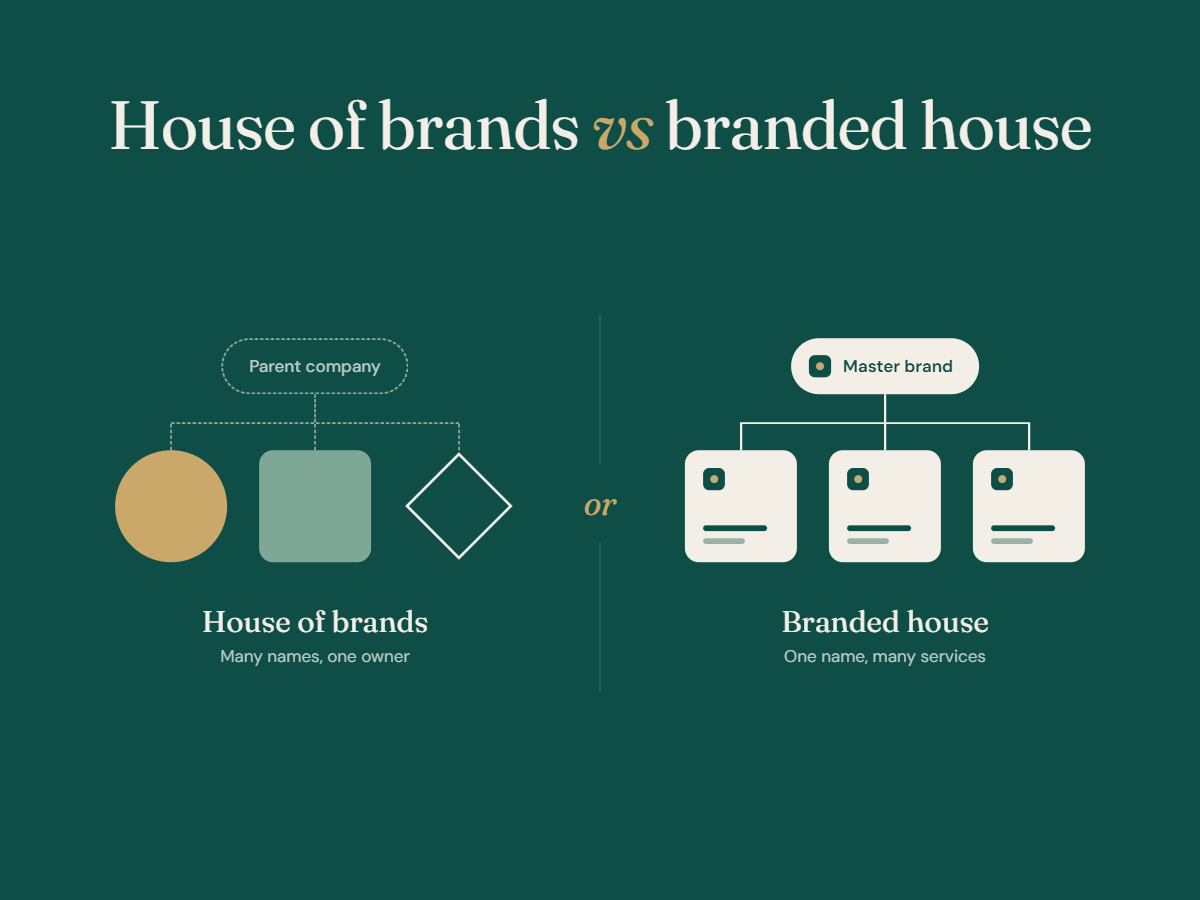
 A house of brands is a parent company that owns a collection of separate, standalone brands. Each brand has its own name, identity, audience and personality. The parent company stays largely in the background.
The textbook example is Procter & Gamble. Olay, Pampers, Gillette and Oral-B all sit under the P&G umbrella, but most shoppers couldn’t tell you that. Each brand earns its own loyalty on its own terms.
Unilever works in much the same way, with Dove, Hellmann’s and Marmite each standing on their own. Diageo does the same with drinks, from Guinness to Johnnie Walker.
What is a branded house?
 A branded house flips that around. There’s one master brand, and everything the business does sits underneath it, usually with a simple descriptor explaining what each part does.
FedEx is a good example. FedEx Express, FedEx Ground, FedEx Office. The descriptor tells you what. The FedEx name tells you who.
When FedEx bought Kinko’s, the well-known print and copy chain was eventually renamed FedEx Office, folding an established brand into the master brand. More recently, FedEx brought its separate operating companies together into a single organisation under the FedEx name.
Apple works the same way with the iPhone, iPad and Mac, and Virgin has put its name to everything from airlines to gyms. Closer to our world, the Big Four accounting firms are branded houses too, putting the firm’s name in front of every service line.
The pros and cons of a house of brands
The pros
- Each brand can speak to its own audience.
- A budget brand and a premium brand can live under the same roof without confusing anyone. Toyota launched Lexus as a separate name rather than asking luxury buyers to pay premium prices for a Toyota badge.
- Risk stays contained.
- If one brand runs into trouble, the damage doesn’t automatically spread to the rest of the portfolio.
- You can compete with yourself.
- P&G sells several laundry brands that sit side by side on the same supermarket shelf. Whichever one the shopper picks, P&G wins.
- Brands are easier to buy and sell.
- Because each brand stands alone, a business can spin one out without rebuilding its whole identity. At the end of 2025, Unilever demerged its entire ice cream business, including Magnum, Ben & Jerry’s and Wall’s, into a standalone company. Shoppers barely noticed, because they’d never been buying “Unilever” in the first place.
The cons
- It’s expensive.
- Every brand needs its own identity, website, social channels and marketing budget. Nothing you invest in one brand helps the others.
- There’s no halo effect.
- A strong reputation in one part of the business does nothing for a new launch elsewhere. Every new brand starts from zero.
- It’s complex to manage.
- More brands means more guidelines, more assets and more opportunities for things to drift.
- For a global consumer goods company with enormous budgets, those costs are manageable. For a professional services firm with a handful of service lines, they usually aren’t.
The pros and cons of a branded house
The pros
- Every pound works across the whole business.
- Every piece of content, every event and every client win builds one name rather than several.
- New services borrow trust.
- A new service launched under an established name starts with credibility on day one, rather than having to earn it from scratch.
- Cross-selling feels natural.
- Clients who already trust you for one service are far more likely to consider another when it carries the same name.
- It’s simpler.
- One name, one story and one set of guidelines. That’s easier for clients to understand and easier for your team to apply.
The cons
- Reputational risk is shared.
- If something goes wrong in one area, it reflects on the whole business.
- There’s a limit to how far a name can stretch.
- If a brand tries to mean too many things, it can end up meaning nothing in particular.
- It’s harder to target very different audiences.
- One master brand can struggle to appeal to both a budget-conscious start-up and a high-net-worth family office at the same time.
- Selling part of the business is harder.
- A division that has always traded under the parent name will need a new identity if it’s ever sold.
Quick Tip: Sketch your current brands on a single page, with lines showing how they connect. If you can’t draw it simply, your clients almost certainly can’t understand it.
The middle ground
In reality, very few businesses are pure examples of either model. Many sit somewhere in between.
Marriott uses what’s known as an endorsed approach, with hotel brands such as Courtyard carrying “by Marriott” alongside their own name. Google went the other way in 2015, creating Alphabet as a parent company that sits behind Google and its sister businesses, while Google itself runs a branded house of Gmail, Google Maps and Google Drive.
Hybrids can work well, but they need clear rules. Without them, they tend to drift into the worst of both worlds.
How to decide which is right for you
If you’re weighing this up for your own business, start with five questions:
1. Do your services share the same clients? If the same people buy from more than one part of your business, a single name makes life easier for everyone.
2. Can you afford to build more than one brand properly? Not just launch it, but market it consistently for years.
3. Would a problem in one area genuinely damage another? If the answer is a firm yes, some separation may be worth the cost.
4. Are you planning to sell part of the business? Standalone brands are easier to separate.
5. Does your main brand name actually reflect what you do? If it’s holding you back, that’s worth fixing before you build anything on top of it.
For most small and mid-sized professional services firms, the answers point towards a branded house. Clients are buying expertise and trust, and both are far easier to build under one name.
How we moved Offshore Group to a branded house
 Offshore Group provides outsourced accounting and payroll to businesses across the Channel Islands and beyond. When they first came to us, they were trading as Offshore Commercial.
The business had grown significantly since relaunching in 2022. That was great news commercially, but the brand hadn’t kept pace. Service areas weren’t clearly defined, branding had become inconsistent between teams and the Offshore Commercial name didn’t reflect the range of industries they actually worked with.
The result was uncertainty in the market about who Offshore served and what they offered. In some cases, their own services were cannibalising each other.
As part of a wider piece of strategy work, we carried out an in-depth audit of their branding and marketing alongside a review of their long-term plans for the business. The conclusion was clear: a branded house, with Offshore Group as the master brand and two sub-brands, Offshore Accounting and Offshore Payroll.
Now the name does the explaining. Offshore Group tells clients who they’re dealing with. Accounting, Payroll and EOR tell them exactly what each team does. And the trust built in one area carries straight across to the other.
From there, we delivered:
– a modernised identity with new logos and full brand guidelines
– stationery, business cards and signage
– digital assets, including social media templates, presentations, desktop backgrounds and LinkedIn headers for staff
– copy for a refreshed website, along with direction and oversight of the build with a third-party agency
Craig Shorto, Offshore’s Managing Director, said the new structure gave the business “a clearer hierarchy that supports both our accounting and payroll services.”
We continue to work alongside Offshore’s leadership as their strategic marketing partner. You can see more of the project here.
Quick Tip: A branded house only works if everyone applies it consistently. Bring your team into the rollout early and give them ready-made templates, so the new brand shows up the same way in every email, proposal and LinkedIn profile.
Final thoughts
Brand architecture can sound like something only multinationals need to worry about. In practice, it’s one of the most useful decisions a growing business can make. Here’s what to take away:
1. Brand architecture is a business decision, not just a design one. It shapes how clients understand you, how your marketing budget is spent and how easily you can grow or sell.
2. For most professional services firms, a branded house is the most efficient choice. One trusted name working across every service will almost always outperform several smaller brands competing for attention.
3. Whichever model you choose, consistency is what makes it work. Clear guidelines, practical templates and a team that understands the why will do more for your brand than any logo.
If your brand has grown faster than its structure, we’d be happy to help you work out the right shape for what comes next. Get in touch to start the conversation.